?Are you looking for a readable, comic-style guide that actually helps you understand cryptography without making your head spin?


Quick summary
You’ll find that The Manga Guide to Cryptography uses a story-driven approach to introduce core cryptographic ideas in a way that feels accessible. The tone is friendly and the visuals help you follow step-by-step explanations, so you can build intuition before tackling formal proofs or heavy math.
What the book covers
This book walks you through many foundational topics in modern cryptography, from simple substitution ciphers to public-key systems and hashing. You’ll learn practical concepts and see how they’re applied, which helps you connect theory to real-world problems.
Topics at a glance
Below is a compact breakdown of typical topics you can expect to encounter in the book and what each section is intended to teach you. This table helps you quickly scan what you’ll get out of each chapter or major unit.
| Chapter / Topic | What you’ll learn | Difficulty | Why it matters |
|---|---|---|---|
| Basic ciphers (Caesar, substitution) | How simple encryption works and its weaknesses | Easy | Introduces the idea of secrecy and frequency analysis |
| Symmetric encryption (block/stream) | Difference between stream and block ciphers; simple examples | Easy–Medium | Shows how shared keys are used in practice |
| Modular arithmetic | Basic number theory used in crypto | Medium | Foundation for RSA, DH and other algorithms |
| Public-key cryptography (RSA) | Key generation, encryption, decryption at a conceptual level | Medium | Enables secure communications without shared secrets |
| Diffie–Hellman key exchange | How two parties agree on a secret over an insecure channel | Medium | Fundamental to secure session key establishment |
| Hash functions | What hashing does and why collision resistance matters | Medium | Used in signatures, integrity checks, and password storage |
| Digital signatures | Concept and role of signatures in authentication | Medium | Ensures integrity and non-repudiation |
| Basic cryptanalysis | Simple attacks and what makes algorithms vulnerable | Medium | Encourages cautious, realistic expectations |
| Protocol sketches | High-level protocols for secure messaging | Medium–Hard | Shows applied cryptography in systems |
| Real-world considerations | Key sizes, side-channel hints, practical pitfalls | Medium–Hard | Helps you apply knowledge safely |


Writing and storytelling
The writing style is conversational, so you’ll rarely feel lost in dry formalism. The narrative frames technical content inside a story that motivates why each concept matters, and that motivation makes the material more memorable.
You’ll notice the text frequently pauses to summarize or restate important points in plain language. That repetition is helpful if you’re new to cryptography because it prevents you from losing track of definitions while you follow examples.
Characters and narrative
Characters are used to create scenarios where cryptographic tools are needed, which gives context to abstract concepts. You’ll likely empathize with a protagonist who faces real problems—like protecting messages or verifying identities—so you see why the math exists.
The narrative isn’t just fluff; it’s used as a teaching device. Dialogues often surface common misconceptions and then correct them, so you get both the right idea and the reasons why other intuitive ideas fail.
Clarity and pacing
Pacing is generally good: simple concepts are introduced first and then built upon, so you won’t be expected to know advanced math upfront. You’ll often see a quick summary after a technical section to reinforce the essentials before moving forward.
If you prefer slow, meticulous progression you’ll appreciate the book’s modular structure, where each idea is developed with examples and then connected to the next idea. That makes it easy to stop and review without losing the thread.
Visuals and layout
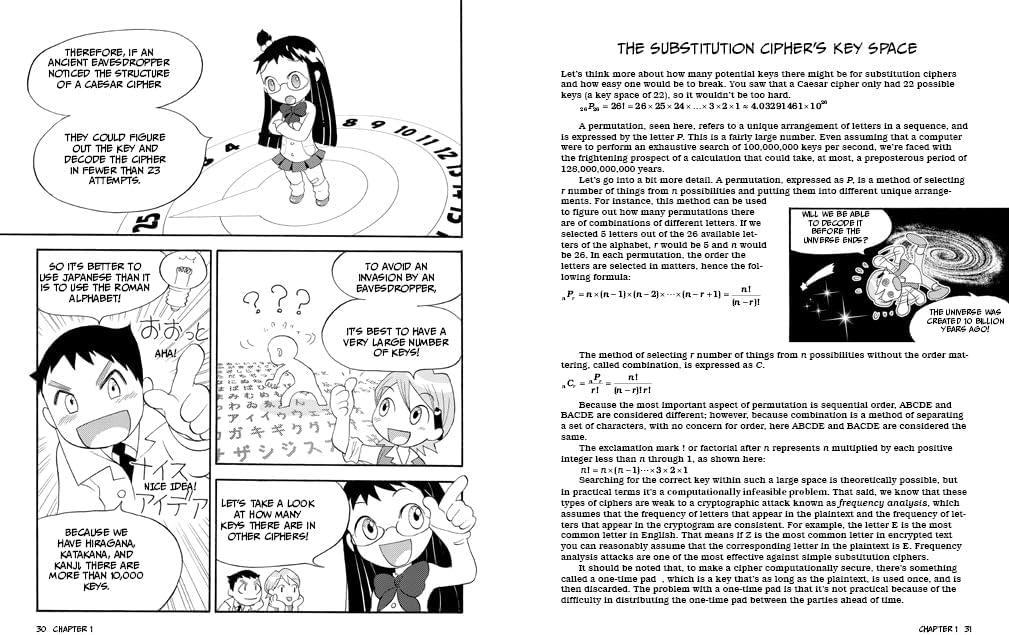
Artwork and layout are designed to guide your attention: panels walk through steps of an algorithm, and callouts highlight formulas and edge cases. The visuals break up dense topics so you can learn via both reading and visual cues.
You’ll find diagrams that show data flow, number line depictions for modular arithmetic, and simplified step-by-step animations rendered as panels. This mix supports both intuitive and analytic learners.
Artwork quality
The art style is typical of the Manga Guide series—clean, expressive, and functional rather than just decorative. You’ll appreciate that faces and gestures are used to signal confusion or revelation, which humanizes technical moments.
Because the art prioritizes clarity, you won’t be distracted by overly stylized pages. The illustrations are intentionally integrated with the text so each panel serves a pedagogical purpose.
Use of diagrams and math
Equations are introduced gradually and accompanied by visual aids that illustrate what each symbol represents. You’ll see worked examples that trace computations step-by-step, which is critical for mathematical topics like modular exponentiation.
The book avoids heavy proof-based presentation and instead focuses on operational understanding: how to compute, what numbers represent, and why results behave the way they do. That helps if your goal is to use cryptography rather than prove theorems.

Teaching approach and pedagogy
The pedagogy centers on “learn by doing”: small examples, guided computations, and questions that prompt you to test intuition. You’ll repeatedly apply concepts in bite-sized exercises, which helps cement understanding without overwhelming you.
This approach works especially well for learners who prefer incremental gains over dense, abstract lectures. As you progress, the book asks you to make small predictions or complete calculations that build confidence.
Hands-on examples and exercises
You’ll find numerous worked problems, often tied to the story’s plot, where characters ask you to perform encryptions or verify signatures. These practice moments are practical and reinforce the algorithmic steps you need to know.
Exercises are typically short and focused, designed to be solvable by hand for small numbers or by simple mental arithmetic. That keeps the learning loop quick: try, check, correct, and repeat.
Suitability for different learners
If you’re a beginner or someone with moderate technical background, you’ll likely find this book approachable and useful. The visual narrative reduces cognitive load and allows you to grasp structural ideas without committing to formal proofs.
If you already have deep mathematical training and want rigorous proofs or cutting-edge cryptographic research, you’ll probably need to supplement this book with more technical texts. Still, it’s a good refresher if you want to sharpen conceptual understanding.
Technical accuracy and depth
The book strikes a balance between accessibility and correctness: it explains how common algorithms operate and why they are used, while avoiding unnecessary formalism. You’ll come away understanding how algorithms work and their practical trade-offs.
For most basic and intermediate topics, the explanations are accurate and the worked examples align with standard algorithms. You’ll get a strong conceptual picture that’s consistent with accepted cryptographic practice.
How rigorous is the math?
The math is presented at a conceptual and computational level rather than a proof-centric level. You’ll see enough number theory to follow RSA and Diffie–Hellman computations, but not the formal security proofs you’d encounter in graduate courses.
If your goal is to compute modular inverses, perform modular exponentiation, and see where key sizes matter, the book is sufficiently rigorous. If you want asymptotic complexity or formal reductionist proofs, you’ll need more advanced sources.
Cryptographic concepts covered in depth
Core concepts like public-key cryptography, hashing, and digital signatures are given solid, practical explanations. You’ll be able to compute toy RSA examples, understand the use of primes, and see why modular arithmetic is central.
Some advanced topics—like elliptic-curve cryptography, zero-knowledge proofs, or formal security models—are typically outside the book’s scope. You’ll get the groundwork needed to approach these topics later, but not full technical mastery.
Strengths
You’ll benefit from the book’s approachable presentation, visual reinforcement, and steady pacing that builds intuition. The story-driven method makes abstract ideas memorable and often clarifies why a particular construction is useful.
You’ll also appreciate that the book highlights real-world pitfalls at a practical level: why small keys are insecure, how poor randomness undermines systems, and what assumptions matter. Those insights help you avoid common beginner mistakes.
Weaknesses and limitations
Because the focus is on intuition and computation, you won’t find formal proofs or exhaustive coverage of advanced topics. If you need a reference for rigorous security definitions or research-level material, this is not the place for it.
Some seasoned readers may find the storytelling approach too lightweight for deeper study, and certain topics may feel summarized rather than explored thoroughly. You’ll want complementary textbooks or papers if your aim is professional cryptanalysis or protocol design.
How to get the most out of the book
Use the book as a conceptual scaffold: follow the worked examples carefully, attempt the practice questions, and re-work computations by hand when necessary. You’ll cement learning faster if you actively compute and verify results rather than passively reading panels.
Annotate pages with your own notes and try to rephrase each concept in your own words. Teaching a friend, or writing short notes about how RSA works or why hashing matters, will help transfer the book’s intuitive knowledge into durable understanding.
Suggested study plan
Start by reading one chapter at a time and doing the examples. You’ll absorb basic ciphers first, then move to modular arithmetic and public-key schemes; pace yourself so you can revisit chapters when needed.
After you finish a chapter, spend 15–30 minutes solving the exercises and checking your work. You’ll retain more by spacing your practice across multiple days and returning to the tougher parts after a short break.
Pairing with other resources
Pair this book with a more formal textbook or online course if you want depth. You’ll find it helpful as a primer before tackling resources that emphasize proofs, formal models, or programming-based cryptography labs.
You can also use online tools or simple scripts to experiment with larger numbers or realistic parameter choices. That way you’ll move from hand-scale toy examples in the book to real-world parameters and implementations.
Practical examples and worked problems
You’ll encounter worked problems that mirror real tasks: encrypting a message, computing a modular inverse, or checking a simple signature. These problems help you see step-by-step how algorithms operate on numbers.
The examples are deliberately small-scale so you can follow calculations manually. That’s an advantage because you’ll build intuition about the flow of operations before automating them in code or libraries.
Sample computation styles
Typical computations show intermediate steps, such as repeated squaring for modular exponentiation or applying Euclid’s algorithm to find gcds and inverses. You’ll learn not just the formulas but how to perform them in practice.
Seeing intermediate steps demystifies processes like key generation and signature verification, making you less likely to get lost when you later read source code or cryptographic libraries.
Real-world considerations and caveats
The book flags practical concerns like the need for good randomness, pitfalls of reusing keys, and why legacy algorithms are insecure. You’ll get a sense of the gap between theoretical constructions and their real implementations.
Security is contextual: you’ll learn that an algorithm’s theoretical strength doesn’t guarantee safety if it’s implemented poorly or used with bad parameters. Those real-world checks are essential to avoid false confidence.
Implementation hints
You’ll find general guidance about key sizes, basic protocol hygiene, and why side channels can break an otherwise secure algorithm. These hints won’t make you an expert implementer, but they’ll sharpen your instincts.
If you’re planning to implement cryptographic primitives, treat the book as a conceptual primer and consult vetted libraries and standards for production work. That approach reduces the risk of subtle but catastrophic mistakes.
Comparison to other resources
Compared with formal textbooks, The Manga Guide to Cryptography is lighter on proofs and heavier on intuition and computation. It fills a niche for learners who prefer visual, story-driven explanations and want a friendly entry point.
Compared to online tutorials or video courses, the book gives durable, portable material you can flip through at your own pace, and the manga format encourages revisiting sections you found tricky.
Who should buy it?
You should consider this book if you’re curious about cryptography, want a non-intimidating route into the subject, or need to explain basics to colleagues or students. It’s especially helpful if you learn visually or prefer narrative contexts for abstract topics.
If your goal is a research career in cryptography, or you need to implement secure systems professionally, use this book as a starting point but plan to supplement it with more technical references.
Price and value
The book generally offers excellent value for the accessible explanations and visual approach it provides. You’ll get a lot of conceptual mileage for a relatively small time investment compared with denser textbooks.
Value also depends on your needs: if you want quick intuition and hands-on practice without the heavy math, you’ll find it worth the price. If you’re seeking exhaustive coverage, be prepared to add additional resources.
Final verdict
You’ll find The Manga Guide to Cryptography to be a friendly, effective introduction that makes cryptographic ideas understandable and engaging. It’s ideal for learners who want to grasp how algorithms work and why they matter without being overwhelmed by dense proofs.
Use it as a conceptual bridge that prepares you for more technical study or as a teaching aid to introduce cryptography in a classroom or group setting. You’ll walk away with solid intuition and the ability to perform basic computations and reason about security choices.
Frequently asked questions
Is this book suitable for total beginners?
Yes. You’ll find the book starts with basic ideas and builds up gradually, so you don’t need prior cryptography or advanced math to benefit from it. The step-by-step examples and visuals help you pick up key skills quickly.
Will I learn to implement real cryptographic systems from this book?
Not entirely. You’ll learn the underlying concepts and how algorithms behave on small examples, but implementing secure, production-grade systems requires deeper study and attention to libraries, standards, and side-channel issues. Treat the book as a conceptual foundation.
How much math do I need before starting?
You only need basic arithmetic and an openness to learning modular arithmetic as presented in the book. You’ll be guided through number theory essentials, so prior advanced math isn’t necessary.
Does the book cover modern topics like elliptic-curve cryptography (ECC)?
The focus is on foundational concepts; advanced topics like ECC may be mentioned but typically aren’t covered in exhaustive detail. If you want ECC or advanced protocols, plan to combine this book with specialized resources.
Is the manga format helpful for learning technical topics?
Yes, if you respond well to visual storytelling and contextual learning. You’ll likely retain ideas better because the narrative and characters create memorable anchors for abstract concepts. If you prefer formal, lecture-style proofs, you might prefer a traditional textbook.
Can this book be used in a classroom?
Absolutely. You’ll find it a great supplementary text for introductory courses or club sessions because it motivates topics and eases students into computation and protocol thinking. Use it alongside problem sets and a more formal reference when deeper understanding is needed.
Should I read this before tackling formal cryptography courses?
It’s a good preparatory read. You’ll gain intuition that makes formal courses easier to follow, so you’ll be less likely to get lost when encountering proofs and advanced models.
How long will it take to get through the book?
That depends on how deeply you practice examples. If you read straight through and do the exercises at a moderate pace, plan on a few days to a couple of weeks to absorb the key ideas. If you rework problems and experiment with code, it may take longer but will be more rewarding.
Are there exercises with solutions?
You’ll usually find worked examples and practice problems; solution coverage varies by edition. You should be ready to try exercises and check your work against the provided walkthroughs or by using small scripts to verify computations.
Is the content still relevant given evolving cryptographic standards?
Yes, the foundational concepts and computational techniques remain relevant because modern cryptography builds on these principles. For up-to-date standards and algorithm recommendations, pair the book with current standards documents or authoritative online sources.
Practical next steps after reading
Try implementing a simple RSA or Diffie–Hellman example using a scripting language to reinforce what you learned. You’ll convert hand-scale calculations into code and then test how changing parameters affects behavior and performance.
Join study groups, forums, or local meetups where you can discuss problems and see different perspectives. You’ll solidify understanding faster by explaining concepts to others and tackling questions you hadn’t considered.
Closing recommendations
If you want a gentle, engaging route into cryptography that emphasizes intuition, The Manga Guide to Cryptography is a strong choice. You’ll come away with practical skills, clearer mental models, and the confidence to continue into more advanced materials.

Disclosure: As an Amazon Associate, I earn from qualifying purchases.