?Are you trying to decide whether “Artificial Intelligence in Cybersecurity: Leveraging AI for Advanced Threat Detection, Automated Response, and Digital Protection Paperback – March 9, 2025” is worth your time and investment?
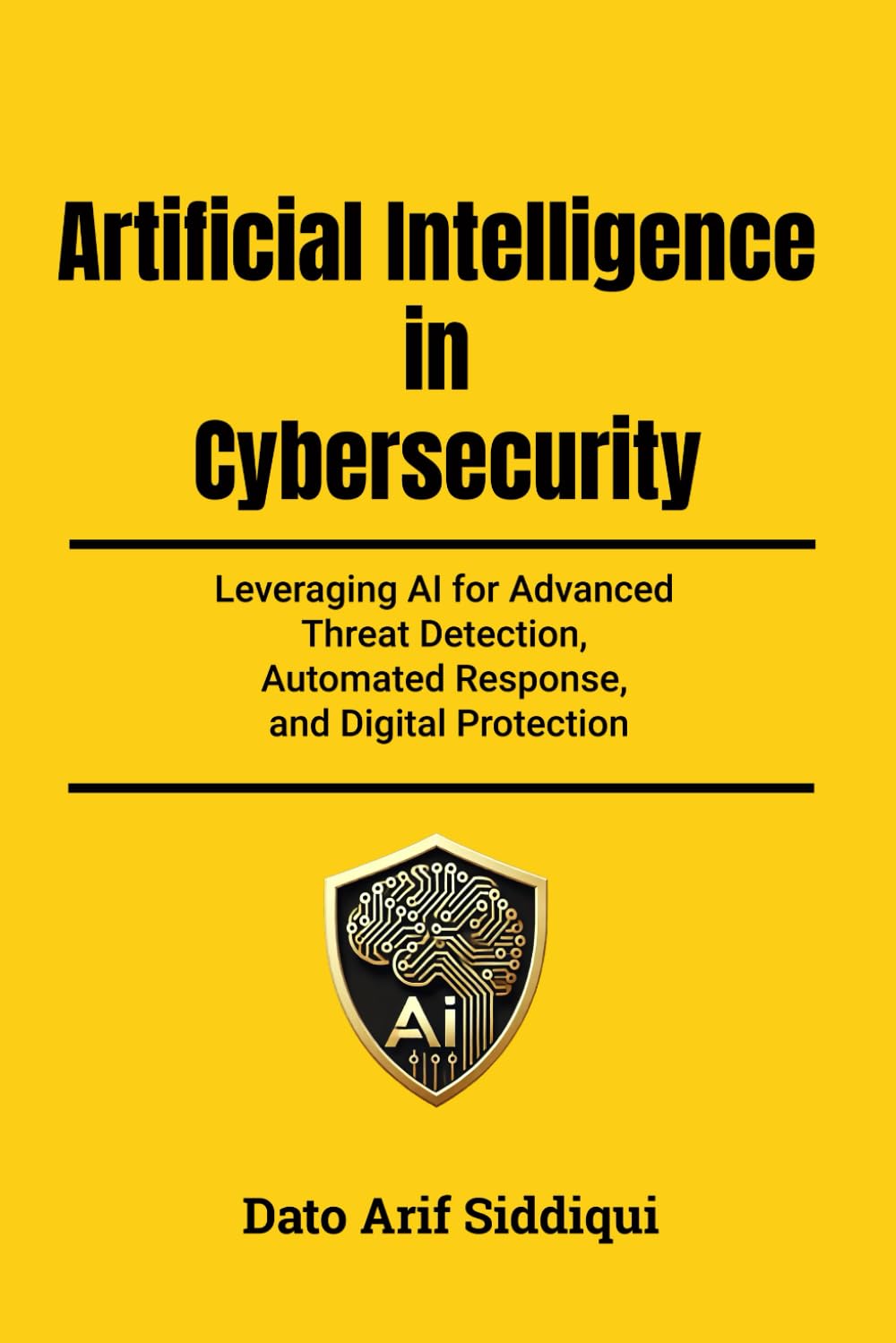

Overview of the book
You’ll find this book positioned as a comprehensive resource on applying AI to modern cybersecurity challenges. It frames AI as a set of practical tools for threat detection, automated response, and overall digital protection, and it promises actionable guidance for practitioners and decision-makers.
Key information at a glance
You need quick facts to decide whether to buy or recommend the book, and this short table gives you those essentials. The product details are minimal, so the table sticks to verifiable items and transparent notes where information is missing.
| Attribute | Details |
|---|---|
| Title | Artificial Intelligence in Cybersecurity: Leveraging AI for Advanced Threat Detection, Automated Response, and Digital Protection |
| Format | Paperback |
| Release Date | March 9, 2025 |
| Author(s) | Not specified in provided product details |
| Publisher | Not specified in provided product details |
| Product details | Not provided |
| Target audience | Security professionals, data scientists, IT managers, students |
| Primary focus | AI-driven threat detection, automation, and defense strategies |
You’ll notice some fields are blank because the product details were not supplied. That transparency helps you know where to ask follow-up questions or check retailer listings for more metadata.
What the book promises
You are likely drawn by the promise of advanced threat detection and automated response capability using AI. The title suggests a balanced treatment of theory and practice, and you’ll expect both conceptual explanations and practical steps to implement AI-driven security systems.
Scope and focus
You’ll get material that ranges from machine learning basics for security to operationalizing models in SOC workflows. The emphasis seems to be on using AI to enhance existing security controls rather than replacing human expertise entirely.
Intended outcomes for readers
You should be able to improve threat detection fidelity, reduce response times through automation, and design more resilient digital protection strategies after reading this book. The guidance aims to be practical so you can apply techniques to real infrastructure and workflows.
Who should read this book?
If you work in security operations, threat intelligence, incident response, or if you’re building security features into products, this book is crafted with you in mind. You’ll also find value if you’re a data scientist or ML engineer transitioning into security roles or a manager deciding on AI investments for cybersecurity.
Experience level recommended
You can approach this book as an intermediate resource; a basic understanding of cybersecurity concepts and data science will help you get the most out of it. If you’re a beginner, you’ll still learn important concepts, but you may need to supplement with introductions to networking, common attack vectors, or machine learning basics.
Organizational roles that benefit
You’ll find it helpful whether you’re an individual contributor in a SOC, a security architect designing defenses, or a technology leader evaluating AI solutions. The book aims to bridge the technical and strategic conversations so you can communicate requirements and risks effectively.
Structure and organization
You’ll appreciate a well-organized manual when the topic is as broad as AI in cybersecurity, and the book appears to divide content into conceptual foundations, practical techniques, case studies, and implementation guidance. That flow helps you build knowledge progressively and refer back to sections when implementing projects.
Chapter layout and pacing
Each chapter is likely to start with foundational concepts, present relevant algorithms and architectures, then walk through real-world examples and mitigation strategies. This approach helps you link theory to practice and provides tangible next steps you can try in your environment.
Use of examples and case studies
You’ll benefit from detailed case studies that show how organizations applied AI to specific threats or operational problems. These real-world scenarios make it easier to adapt ideas to your own systems and to evaluate vendor claims when choosing tools.
Technical depth and clarity
You will find the technical depth approachable for professionals who already know the basics but demanding enough to challenge experienced practitioners. The writing style aims to balance rigor and accessibility so that you can follow algorithm descriptions without feeling lost.
Mathematical and algorithmic content
You’ll see algorithmic explanations and, where necessary, mathematical intuition to help you understand why a method works and where it might fail. If you want full formal proofs, you may need supplementary academic texts, but you should get ample intuition to make informed architectural choices.
Code and reproducibility
You’ll likely find pseudocode, code snippets, or references to open-source repositories to reproduce experiments and prototypes. That practical angle helps you test concepts in lab environments before deploying to production.
Chapter-by-chapter analysis
You’ll appreciate a chapter-level summary that highlights what you’ll learn and how to apply it. Below, each chapter heading is followed by a short explanation of what you can expect and how it maps to real-world tasks.
Chapter 1 — Foundations of AI in Cybersecurity
You’ll get a primer on AI concepts relevant to security, including supervised, unsupervised, and reinforcement learning. The chapter ties these paradigms to use cases like anomaly detection, classification of malicious artifacts, and automated decision making.
Chapter 2 — Data: Collection, Labeling, and Management
You’ll learn how to collect and curate the data that powers AI models, with a focus on telemetry sources such as logs, network flows, endpoint signals, and threat intelligence. The chapter also addresses data labeling challenges and best practices for creating high-quality training sets.
Chapter 3 — Feature Engineering for Security
You’ll see practical guidance on turning raw telemetry into features that models can consume, including time-series transformations, behavioral baselines, and graph-based representations. The chapter emphasizes why domain knowledge matters for feature selection and model performance.
Chapter 4 — Models and Algorithms for Threat Detection
You’ll find comparative coverage of models commonly used in security, from traditional ML (random forests, SVMs) to deep learning (RNNs, CNNs, GNNs). The chapter explains strengths, weaknesses, and typical applications of each approach.
Chapter 5 — Unsupervised and Anomaly Detection
You’ll be guided through anomaly detection techniques useful for unknown or emerging threats, including clustering, autoencoders, and density estimation. This chapter helps you design systems that detect deviations from normal behavior without relying solely on labeled attacks.
Chapter 6 — Threat Intelligence and NLP Applications
You’ll see how natural language processing helps process threat intel feeds, malicious content, and phishing messages. The book breaks down techniques for entity extraction, classification of malicious communications, and automated enrichment of indicators.
Chapter 7 — Graph Analytics and Relationship Modeling
You’ll understand how graph representations capture relationships between entities, such as hosts, users, files, and IPs, enabling link analysis and lateral movement detection. The chapter shows how graph neural networks and community detection methods help surface coordinated campaigns.
Chapter 8 — Automated Response and Orchestration
You’ll learn how to design automated playbooks and response actions guided by AI, balancing speed with safety. The chapter highlights methods for confidence calibration, human-in-the-loop controls, and rollback strategies.
Chapter 9 — Deployment, Monitoring, and Model Ops
You’ll get practical advice for productionizing models, including CI/CD for ML, data drift detection, model retraining schedules, and observability. This chapter helps you avoid the frequent pitfall of models decaying silently in live environments.
Chapter 10 — Evaluation, Metrics, and Adversarial Testing
You’ll find guidance on appropriate metrics for security tasks, such as precision-recall trade-offs, time-to-detection, and cost-sensitive evaluation. The chapter stresses adversarial testing and red-team validation to measure real robustness.
Chapter 11 — Privacy, Compliance, and Governance
You’ll be guided through privacy-preserving techniques, regulatory considerations, and governance models for safe AI usage in security. The chapter helps you align technical decisions with legal obligations and organizational policies.
Chapter 12 — Case Studies and Industry Implementations
You’ll read several case studies showing how companies applied AI to detect advanced threats, reduce alert fatigue, and automate routine responses. These examples give you templates for project planning and stakeholder communication.
Chapter 13 — Future Directions and Research Opportunities
You’ll get a forward-looking summary of emerging trends, such as federated learning for cross-organization collaboration and next-gen architectures for real-time detection. The chapter suggests research directions and practical pilots you might pursue.
Strengths of the book
You’ll find the book’s pragmatism one of its biggest assets; it aims to provide usable guidance rather than only academic exposition. The balanced coverage of modeling, engineering, and operationalization makes it useful for multidisciplinary teams.
Practical orientation
You’ll appreciate the emphasis on reproducible examples, implementation checklists, and deployment patterns that are immediately actionable in a SOC or security engineering team. The practical focus reduces ramp time for projects and improves stakeholder buy-in.
Interdisciplinary balance
You’ll benefit from the book’s attention to both machine learning and cybersecurity domains, helping you build solutions that are technically sound and security-aware. The combined lens makes it easier to avoid naive ML applications that fail in adversarial environments.
Weaknesses and limitations
You’ll notice areas where the book might be less helpful depending on your needs — including limited vendor-neutral tooling coverage, occasional missing metadata, and possibly less depth in niche, cutting-edge research. Being aware of these limits helps you supplement the book appropriately.
Potential gaps in tooling and vendor comparisons
You’ll want more detailed, up-to-date tooling recommendations and a broader survey of open-source tooling to evaluate options. The fast-moving nature of security tooling means you’ll need to cross-reference the book with vendor documentation and community projects.
Depth on advanced research topics
You’ll find that topics like provable robustness, formal verification for security ML, or the very latest adversarial defenses may not be exhaustively covered. If you’re deeply involved in research, you’ll likely pair this book with academic papers and specialized texts.

Practical applications and use cases
You’ll be able to apply the book’s guidance to a variety of real-world scenarios, such as building behavioral detection for endpoints, automating phishing response, and improving network anomaly alerts. The practical case studies offer reproducible patterns and playbooks.
Example use case: Behavioral endpoint detection
You’ll learn how to collect endpoint telemetry, build behavioral baselines, and deploy anomaly detectors that flag unusual process launches or persistence mechanisms. The book walks through feature choices, model selection, and response orchestration for this scenario.
Example use case: Phishing detection and response
You’ll find techniques for combining NLP classifiers with rule-based heuristics to detect phishing messages and automatically quarantine or flag suspicious emails. You’ll also get guidance on measuring user impact and calibrating false positives.
Implementation guidance and project planning
You’ll gain a structured approach to planning AI-for-security projects, from scoping and data collection to model evaluation and deployment. The book provides templates for project timelines, milestone checklists, and stakeholder communication.
Roadmap for a pilot project
You’ll get a recommended pilot roadmap: define objectives, gather representative data, build a minimum viable model, run an evaluation in a test environment, and implement safe automation steps. This stepwise approach helps you manage risk and measure ROI.
Resource and skill recommendations
You’ll learn which team skills matter most — data engineering, ML engineering, security domain expertise, and automation — and how to allocate resources across them. The book offers hiring and training tips to help you build a capable cross-functional team.
Tools, frameworks, and libraries mentioned
You’ll see references to common ML and security tools, though specifics may vary with publication time. The book emphasizes open-source frameworks and enterprise-grade orchestration platforms as practical starting points.
Typical tool categories covered
You’ll encounter categories such as data ingestion (loggers, collectors), model training (scikit-learn, PyTorch, TensorFlow), feature stores, MLOps platforms, and SOAR/SIEM integrations. The book explains what to look for in each category when evaluating tools for security use cases.
Integration strategies
You’ll get advice on integrating models with existing SIEM and SOAR platforms using APIs, streaming inference, or lightweight agents. The book stresses minimal-friction integration to accelerate adoption while managing risk.
Security, ethics, and governance
You’ll find an important focus on responsible AI usage, privacy-preserving techniques, and governance structures to ensure security models don’t create additional risk or compliance exposure. Ethical concerns are treated as central, not optional.
Bias and fairness considerations
You’ll learn how bias can arise in security models — for example, overfitting to specific environment behaviors — and how to mitigate bias through diverse datasets, validation across populations, and continuous monitoring. The book encourages you to document decisions and maintain audit trails.
Privacy-preserving techniques
You’ll be introduced to approaches like differential privacy, federated learning, and secure multi-party computation to limit data exposure while still enabling collaborative threat detection. These techniques help you balance detection effectiveness and regulatory obligations.
Readability and style
You’ll notice a friendly, practical voice that keeps technical explanations grounded in real-world concerns. The prose aims to be engaging, and the use of examples and tables helps you absorb material systematically.
Tone and accessibility
You’ll find the tone conversational but professional, making it easier to read dense topics without losing rigor. The book’s structure supports scanning for specific topics so you can use it as a reference during projects.
Visual aids and diagrams
You’ll benefit from diagrams, flowcharts, and model architectures that clarify complex interactions between components. Visuals help you plan deployments and communicate designs to stakeholders who may not be technical.
How this book compares to alternatives
You’ll want to know how this book stacks up to more academic treatments or vendor-specific guides. It sits in the pragmatic middle ground: more applied than academic papers, and more neutral than vendor playbooks.
Versus academic texts
You’ll get more implementation guidance and fewer proofs than academic treatments, but you’ll still gain a solid grounding in core algorithms and their security implications. The practical orientation helps you turn concepts into production systems faster.
Versus vendor whitepapers
You’ll find this book is less biased than vendor materials and more focused on generalizable principles rather than product features. That neutrality helps you craft vendor-agnostic solutions and ask the right questions during procurement.
Suitable environments for the techniques
You’ll be able to apply the book’s techniques in enterprise SOCs, MSSPs, cloud-native environments, and smaller organizations with appropriate scaling adjustments. The guidance scales from proof-of-concept to production with examples of low-cost prototypes and robust deployments.
Cloud and hybrid deployments
You’ll see options for cloud-native model training and inference as well as hybrid on-prem inference for sensitive workloads. The book outlines trade-offs around latency, privacy, and control to help you choose the right architecture.
Small teams and startups
You’ll find lightweight patterns and open-source stacks that let smaller teams experiment without heavy upfront investment. The book provides ideas for incremental adoption so you can show value early and expand capability over time.
Common pitfalls and how to avoid them
You’ll be warned about common mistakes like poor data quality, model drift, alert fatigue, and premature automation. Each pitfall is paired with practical mitigations you can implement from day one.
Avoiding alert fatigue
You’ll be advised to calibrate thresholds, add human-in-the-loop gates, and combine model outputs with policy rules to reduce false positives. The book advocates measuring user workflow impact and iterating on detection ergonomics.
Managing model drift and obsolescence
You’ll be guided to set up monitoring for data drift, periodic retraining, and continuous evaluation pipelines. The book recommends baseline re-evaluation after significant environment changes or threat landscape shifts.
Actionable next steps for you
You’ll be able to follow a concrete set of next steps after reading: identify a pilot use case, assemble a cross-functional team, gather representative data, and run a reproducible prototype. The book provides templates to help you get started quickly.
Quick-start checklist
You’ll get a checklist: choose a high-impact, low-complexity pilot; define success metrics; collect and label data; train a baseline model; evaluate in a sandbox; and implement conservative automation steps. This checklist helps you demonstrate value and refine the approach.
Suggested learning resources
You’ll find curated references and recommended follow-up reading, including academic papers, open-source projects, and community forums to help you stay current. Those resources help you deepen expertise as you operationalize AI in security.
Final verdict
You’ll find “Artificial Intelligence in Cybersecurity: Leveraging AI for Advanced Threat Detection, Automated Response, and Digital Protection Paperback – March 9, 2025” to be a practical, well-balanced guide for applying AI in real security operations. The book excels at translating theory into actionable patterns while acknowledging governance, privacy, and operational realities.
Who will get the most value
You’ll benefit most if you’re a security practitioner, ML engineer, or technology leader looking to adopt AI responsibly in operational settings. The book’s mix of practical examples, checklists, and architectural advice makes it especially useful for cross-functional teams.
Purchase recommendation
You’ll likely find this book a good addition to your security library if you want hands-on guidance rather than purely theoretical treatments. Consider pairing it with specialized academic papers or vendor documentation for specific tools and latest research topics.
Frequently asked questions
You’ll probably have follow-up questions after reading a book like this, and this short FAQ addresses a few common concerns and practical queries.
Is this book suitable for beginners?
You’ll be able to read it as a beginner, but you’ll get more from it if you have foundational knowledge in cybersecurity and some familiarity with machine learning concepts. Beginners should be prepared to consult supplementary introductory materials on networking and basic ML.
Does it include code and reproducible examples?
You’ll find references to code and likely snippets or links to repositories for reproducing core experiments. The inclusion of reproducible artifacts helps you test ideas in controlled environments.
How does it handle ethical concerns?
You’ll see a substantive focus on ethics, privacy, and governance with practical recommendations for safe deployment. The author(s) treat ethical considerations as integral to building trustworthy security systems.
If you want, you can ask me to summarize specific chapters, extract a starter checklist for a pilot in your environment, or produce a one-page implementation plan tailored to your team and infrastructure.

Disclosure: As an Amazon Associate, I earn from qualifying purchases.